FACT-CHECK RECORD
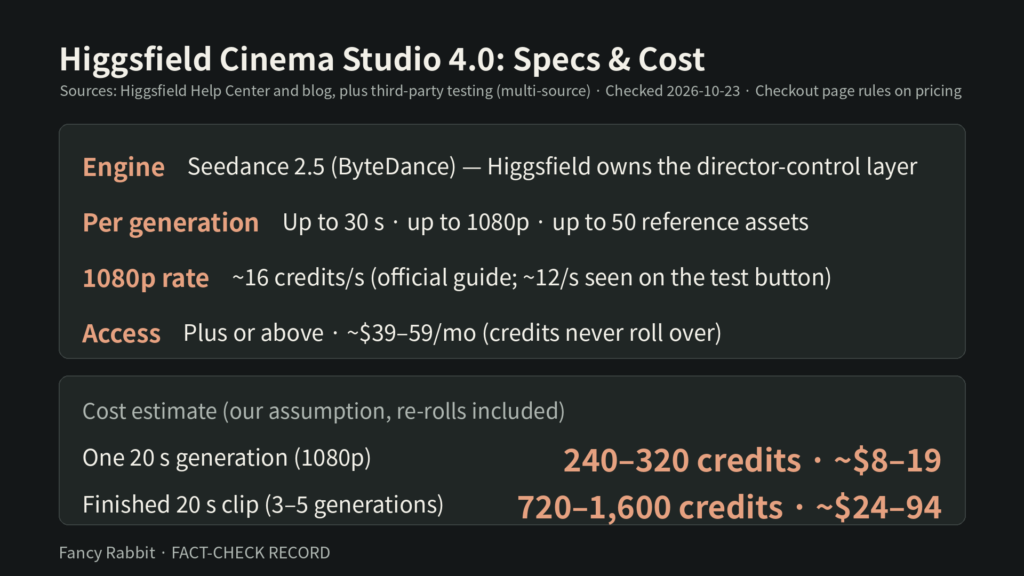
Higgsfield, Fact-Checked: How Was That One-Kernel Popcorn "Experiment" Actually Made?
The engine is Seedance 2.5, the showcase is a 1-in-64 survivor sample, and the terms allow training. We passed.

FACT-CHECK RECORD
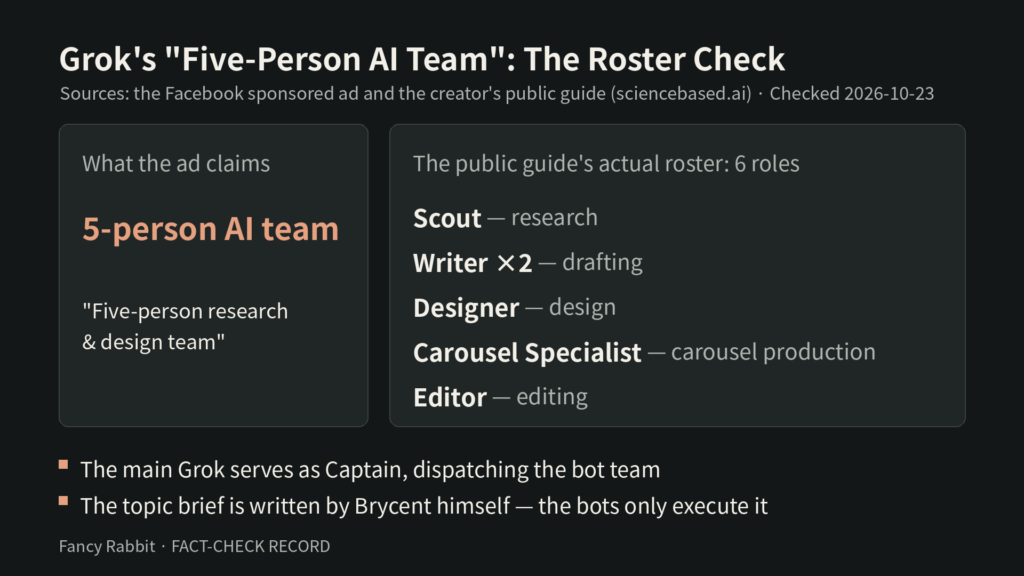
The ad says five-person team; the guide lists six roles, human-written briefs, and a paid publisher. We passed.
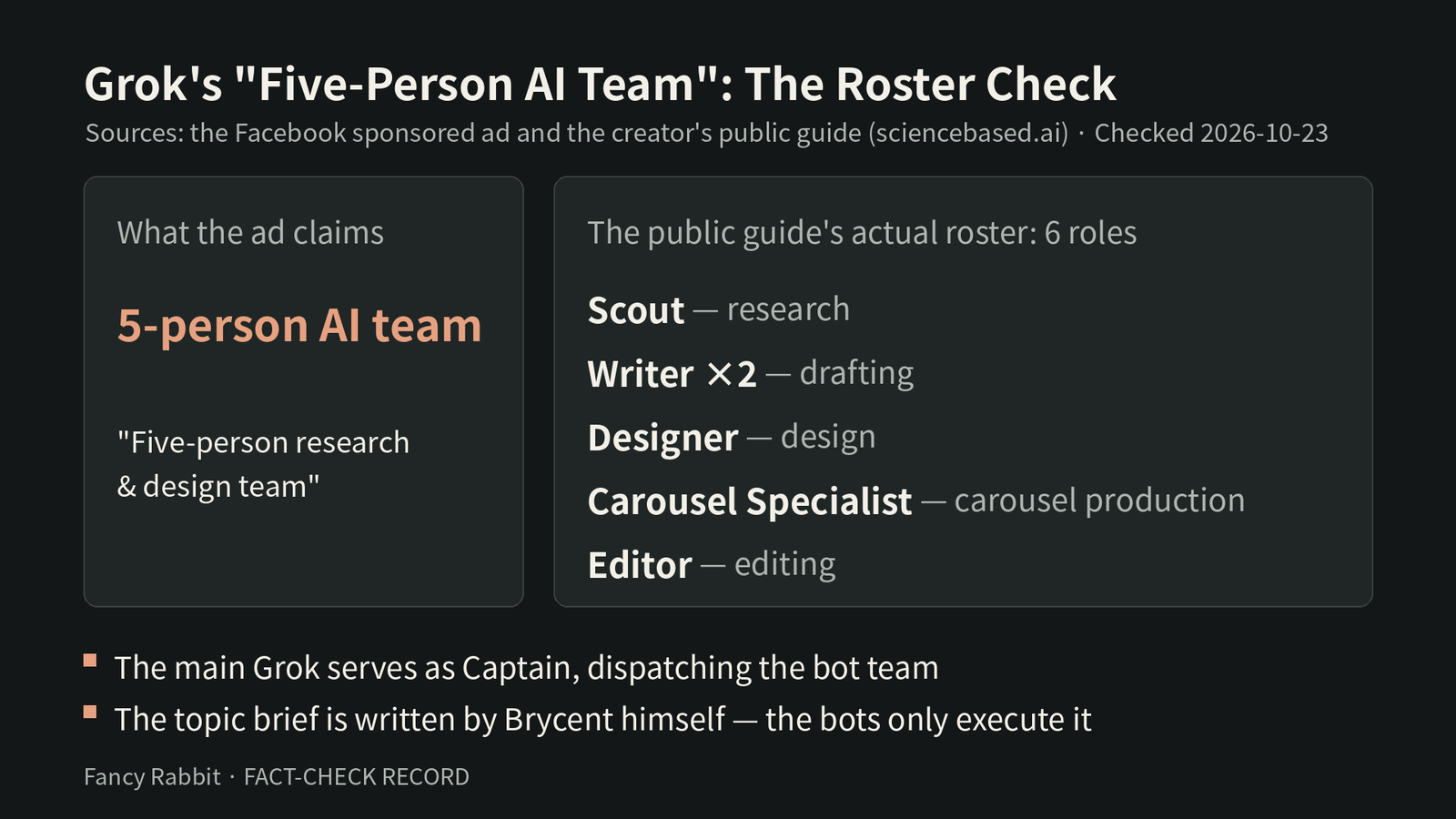
A sponsored Facebook ad (page “Brycent – Startups & Venture Capital”, 28K views) demonstrates building a “five-person research and design team” with Grok that finds startup news and turns it into ready-to-publish Instagram carousels. We tracked down its public setup guide and took the whole thing apart. The team can genuinely be built — but the ad leaves out three things: the topic ranking is written by the creator himself in a brief the bots merely execute; “ready to publish” sits behind human review, a score-and-reject loop, and a separate paid publishing tool; and the true cost is three stacked bills, of which the ad mentions only the first. Our verdict: do not subscribe, do not adopt. But two of its workflow disciplines are worth stealing, and we have already transplanted them into our own process (see the end).
The guide’s prompt framework has five parts — Role / Goal / Inputs / Process / Quality bar — plus five variables: brand, topic, audience, voice, and a design template. Its single most steal-worthy principle: never describe taste with adjectives; give examples. The ad’s screenshots show exactly that — the house style was extracted from one existing Instagram post (seven slides, a big-money hook up front) and every later carousel is fitted to it.
Grok Bot puts all of a user’s bots on a single shared cloud computer, with login states and files in common, and no described security boundary between individual bots. If one bot is manipulated into doing something it shouldn’t, every connected service and credential on that machine is within reach. That runs directly against our studio’s governance: primary accounts are never handed to automation, permissions stay minimal, and sensitive actions are approved one by one. Its “pause for approval” design blocks deliberate actions; it does not contain shared-environment exposure.
Because its pipeline discipline is genuinely good — we just don’t need to change platforms to get it: monitor topics → rank them in a brief → divide the writing → score and reject independently → human approval → scheduled publishing. We already run a stricter equivalent of that chain in our current tooling (project workstreams, tiered approvals, schedules, ledgers). The only increment worth paying extra for is Grok’s native real-time X data for trend intelligence — and paying three stacked bills for that one item doesn’t pencil out.
Two transplants are already official here: a social-copy review scorecard (every draft scored on evidence, voice, structure, and CTA before it may go to approval) and an IP social style card (slide counts, hook patterns, layout, and banned items, reverse-extracted from approved work). Both were finalized on 2026-10-24 and written into this site’s workflow.
My verdict: do not subscribe, do not adopt — steal the pipeline discipline instead. The team is real, and so are the three omissions: the topic brief is human-written, “ready to publish” sits behind review scoring and a separate paid tool, and the cost is three stacked bills. We have already transplanted the review scorecard and the social style card into our own workflow (finalized 2026-10-24); there is no need to pay Grok’s three bills for those two disciplines.
The team can be built and the guide is public — but it actually specifies six roles, and the topic brief is written by the creator himself first. “Five-person” is the ad’s phrasing and does not match his own guide.
No. Grok Bot has no native social publishing; a paid third-party publishing tool is required, and its own documented flow still requires human approval before scheduling.
Tiered subscriptions run $10–$300/month (reshuffled repeatedly in 2026; the checkout page is authoritative). Grok Bot has no standalone plan — eligibility comes via a paid Cursor plan or SuperGrok, plus an unpublished weekly usage quota.
No. This is a desk-research teardown: on 2026-10-23 we decided not to subscribe and not to adopt it. Pricing data is multi-source tracking; xAI’s official pages were not verified page by page, and we say so here on purpose.
Every week, Fancy Rabbit fact-checks one heavily promoted AI tool: official documents and traceable evidence only, ad claims checked line by line, and an honest note when we neither subscribed nor trialed something — and why. Subscribe to the Fancy Rabbit notes and the next report lands in your inbox.
Reviews, pricing, and hands-on notes for each tool — including where the ad claims and the actual terms diverge — are kept current at DC Affiliate.
From tool selection and account governance to workflow design, this approach is available as a done-for-you or advisory service at David Chen Studio.
FACT-CHECK RECORD
The engine is Seedance 2.5, the showcase is a 1-in-64 survivor sample, and the terms allow training. We passed.
FACT-CHECK RECORD
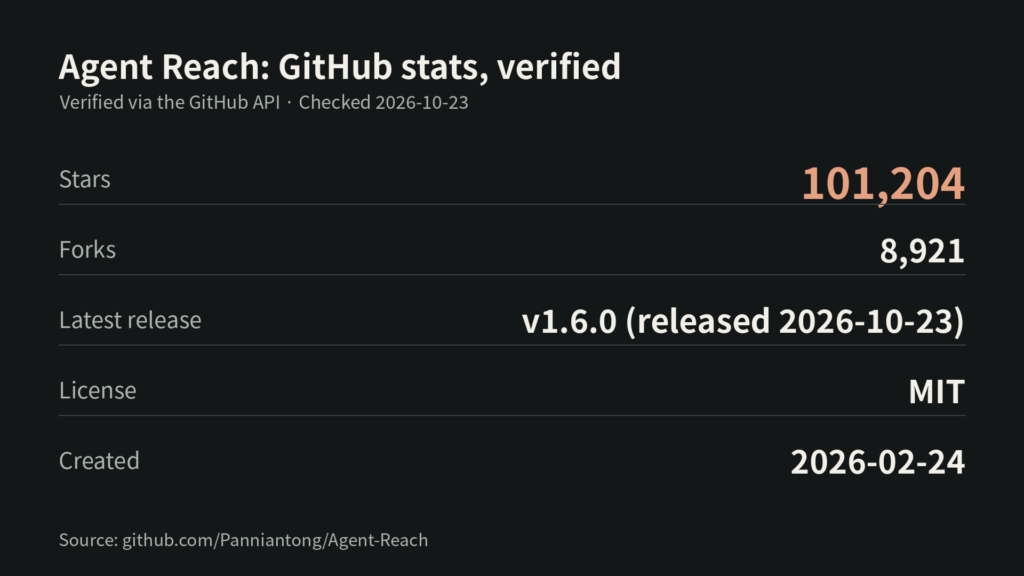
The 100K stars are real. The price is your browser cookies — and why we did not install it.