FACT-CHECK RECORD
Inside Grok's "Five-Person AI Team": How the Ad's Content Factory Is Actually Built
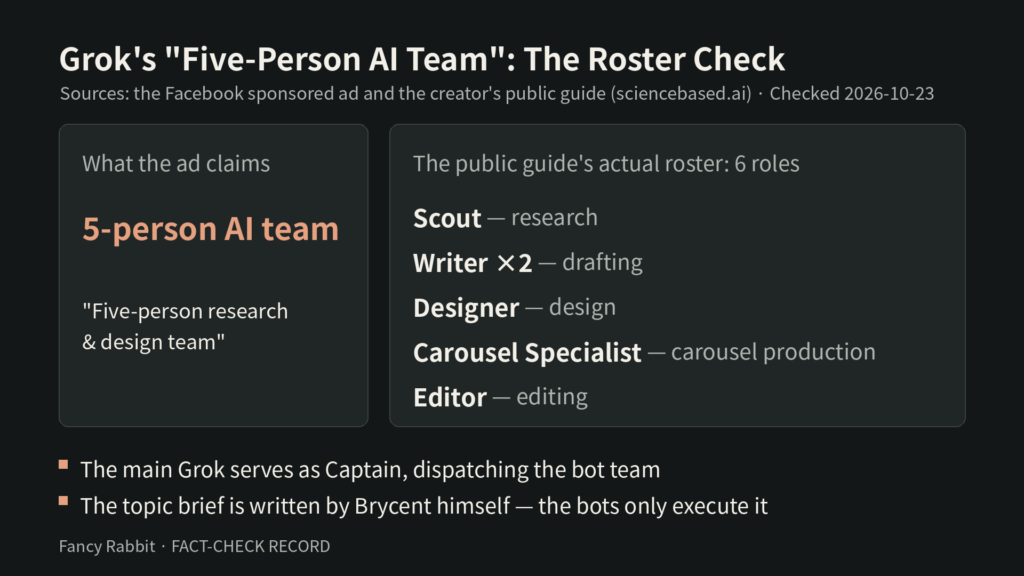
The ad says five-person team; the guide lists six roles, human-written briefs, and a paid publisher. We passed.

FACT-CHECK RECORD
The engine is Seedance 2.5, the showcase is a 1-in-64 survivor sample, and the terms allow training. We passed.
That viral “one popcorn kernel experiment gone wrong” clip (by Ainar Grinberg, posted 2026-10-22) says in its own caption that it is a Higgsfield affiliate promotion: subscribe through his link and he earns a commission. We pulled apart the official Cinema Studio 4.0 documentation and independent hands-on testing, and three things stand out. First, there is no secret sauce: Cinema Studio 4.0’s generation engine is ByteDance’s Seedance 2.5 (the official help center says so), and what Higgsfield owns is the director-control layer around it. The clip’s method can be approximately reconstructed from documented features alone — one locked hero frame, a single continuous shot, and a prompt written beat by beat. Second, discount the wow factor: showcase clips are survivor samples. Higgsfield’s own AI feature film needed 64 generations for every usable shot. Third, our decision is to neither subscribe nor adopt it: third-party testing shows shaky consistency, and the terms let the platform train on your uploads and outputs by default — unreleased original material never goes up. That is our red line.
The creator has published no making-of at all: no prompt, no settings, no runtime, no generation count. What follows is a reconstruction from documented features — an estimate, not a fact:
Step 4 is the point: the chaos is not improvised by the model — the rhythm of the chaos is written into the prompt, beat by beat. That is also the core of Higgsfield’s own teaching: settings first, prompt second. The technical vocabulary (camera bodies, lenses, apertures, 30+ camera-move presets) lives in the panels; the prompt only handles scene, performance and timeline.
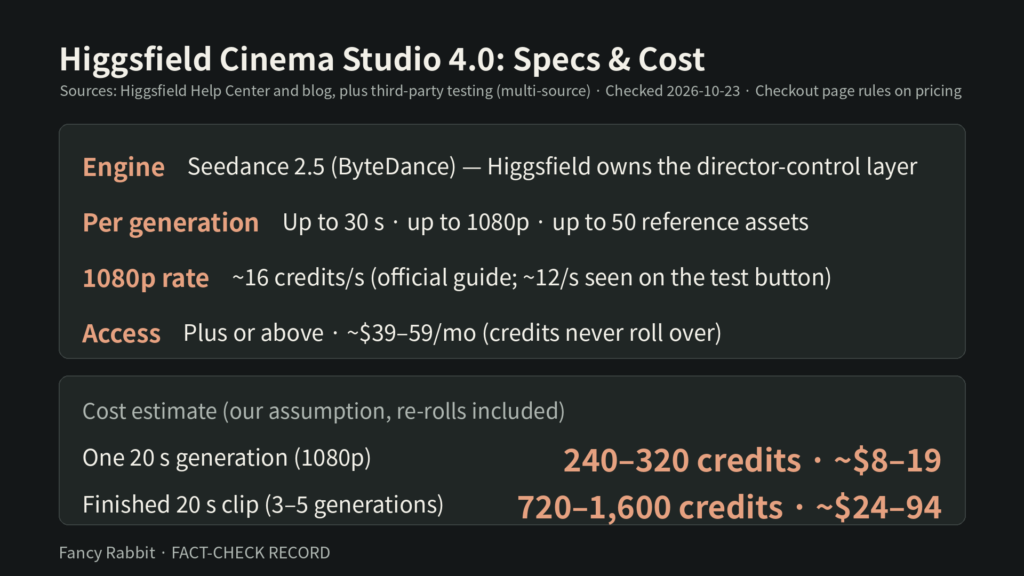
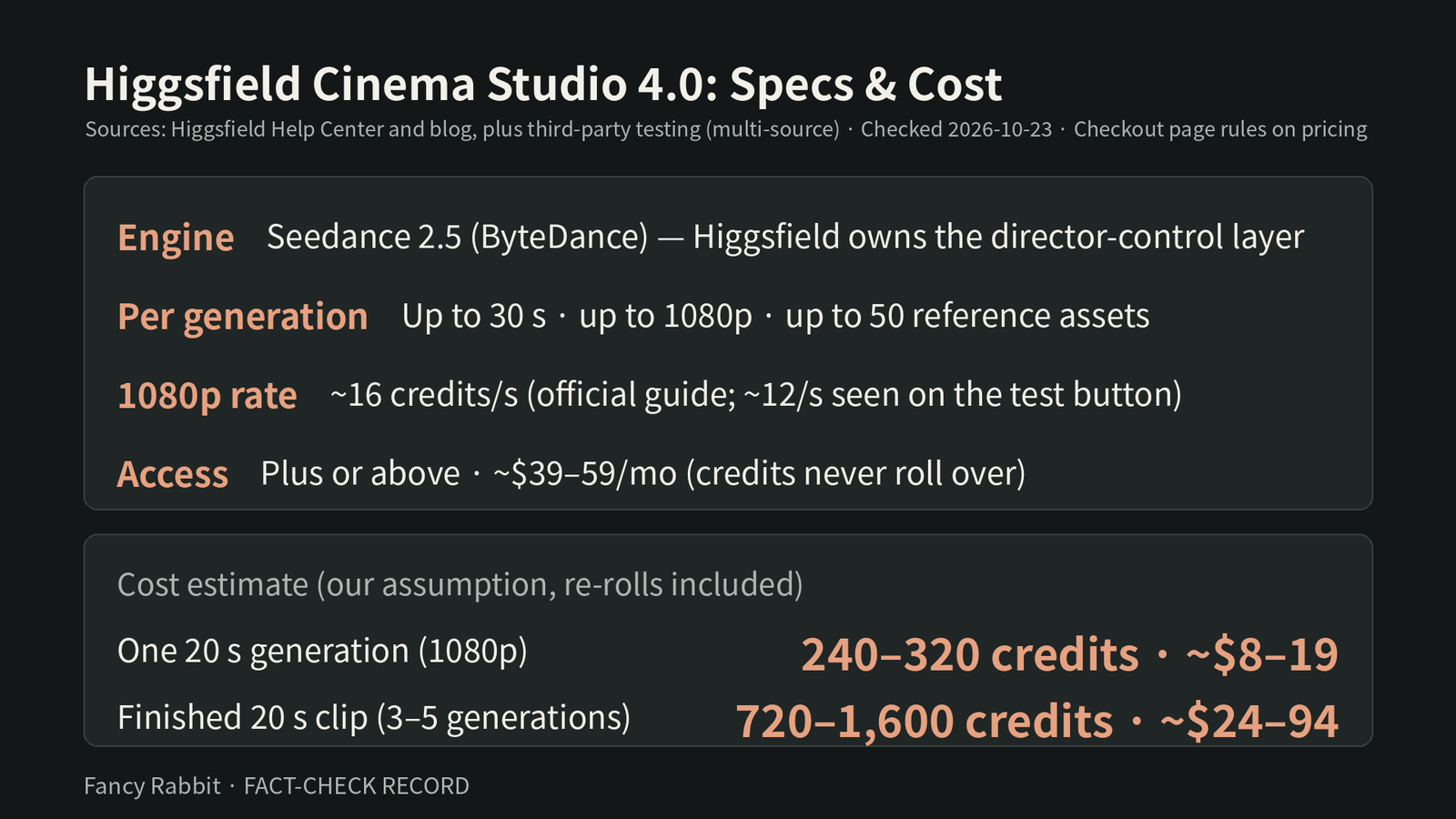
The official guide lists Cinema Studio 4.0 at 16 credits/second at 1080p, 7/second at 720p and 3/second at 480p, and calls it the platform’s most credit-hungry option outright. But in a third-party test, the generate button quoted 60 credits for 5 seconds at 1080p (about 12/second) — treat the guide as a ceiling and the button as the truth. Conversion basis: subscription credits work out to roughly $0.033–0.059 each (monthly price divided by monthly allowance; Plus is about $39–59 for 1,000–1,200 credits, Ultra about $99–129 for 3,000). On that basis, one 20-second generation at 1080p costs about 240–320 credits, roughly $8–19. And generative video means re-rolls: assuming 3–5 generations in total (our assumption, stated as such), a finished 20-second clip lands at about 720–1,600 credits, roughly $24–94 — between 0.6 and 1.6 months of a Plus allowance. The sane path is resolution staging: test at 480p (3 credits/second), finalize at 1080p — the most practical feature in the whole design, and the second discipline we are borrowing. Also note: subscription credits never roll over and expire at cycle end, and the pricing page shows different numbers by region and session, so the checkout page rules.
A sample-size warning first: most of this comes from a single third-party hands-on review (SaaS CRM Review) — one Cinema Studio shot, one Soul ID test. Treat it as a risk signal, not a verdict.
The good news first: output (on any plan) carries no commercial-use restrictions — ads, brand social, products, client work and YouTube monetization are all allowed; the platform claims no ownership of outputs, and rights in already-exported work survive cancellation. The bad news is in the same terms: non-Enterprise users grant Higgsfield a default license to use their uploads and outputs to “train, develop and improve” its AI models; only an Enterprise contract excludes it entirely, and even the Team plan’s comparison table shows “no training on your data” crossed out. Deleting content or your account stops future use, but effects already inside a model cannot be withdrawn. If you hold unreleased original IP, that clause matters more than the price. Also: likeness rights for real people are your responsibility; where the law or a publishing platform requires it, AI-generated content must be disclosed; free and trial outputs are watermarked.
Calibrate with the numbers Higgsfield itself gave the media (not independently verified by us): its in-house 95-minute AI feature Hell Grind took a 15-person team two weeks and a budget under $500,000, most of it compute; the first 25 minutes used 16,181 generations to cut 253 usable shots — about 1 in 64. Prompts averaged around 3,000 words each, and the CEO described the process as “a slot machine”. An affiliate showcase clip is the one pull that paid out, selected from many. The affiliate program pays up to 25% commission, recurring on renewals for 12 months (the creator’s own tier is undisclosed), so his incentive is to make it look like one click. The popcorn clip is genuinely well made — but it proves “selectable”, not “rollable”.
My verdict: do not subscribe, do not adopt — watchlist only. The engine is Seedance 2.5; the director-control layer is what Higgsfield owns. The clip’s method is no secret sauce — a locked hero frame, a single continuous shot, and a beat-by-beat prompt. But showcase clips are survivor samples (the company’s own feature ran about 1 in 64), and the terms license training on user uploads and outputs by default, so unreleased original IP stays off the platform. We are borrowing the beat-structured prompts and the low-resolution-draft discipline into our own video pipeline — no subscription required.
No. The official help center states that 4.0 runs on ByteDance’s Seedance 2.5. What Higgsfield owns is the director-control layer — shooting settings, the Elements system, grading, and the workflow around them.
Unverifiable. The creator has disclosed no prompt, settings, runtime or generation count. Under 30 seconds it is mechanically possible in one generation, but showcase clips are normally selected from multiple attempts, so the surface proves nothing.
Cinema Studio 4.0 requires Plus or above (about $39–59/month). Generation at 1080p is 16 credits/second per the official guide and about 12/second on the button a third-party test observed; a finished 20-second clip (assuming 3–5 generations in total) works out to roughly $24–94 (checked 2026-10-23; rates change often — the checkout page and the generate button rule).
Yes — the terms place no restriction on commercial use, and rights in exported work survive cancellation. But the terms also license the platform to train on your content by default (deletion stops future use but cannot withdraw effects already in a model; full exclusion requires an Enterprise contract), so think before uploading unreleased material.
No. This is a desk-research fact-check: on 2026-10-23 we decided not to subscribe and not to adopt it; we never registered or paid. The production reconstruction above is labeled as an estimate throughout.
Every week, Fancy Rabbit fact-checks one heavily promoted AI tool: official documents and traceable evidence only, ad claims checked line by line, and an honest note when we neither subscribed nor trialed something — and why. Subscribe to the Fancy Rabbit notes and the next report lands in your inbox.
Reviews, pricing, and hands-on notes for each tool — including where the ad claims and the actual terms diverge — are kept current at DC Affiliate.
From tool selection and account governance to workflow design, this approach is available as a done-for-you or advisory service at David Chen Studio.
FACT-CHECK RECORD
The ad says five-person team; the guide lists six roles, human-written briefs, and a paid publisher. We passed.
FACT-CHECK RECORD
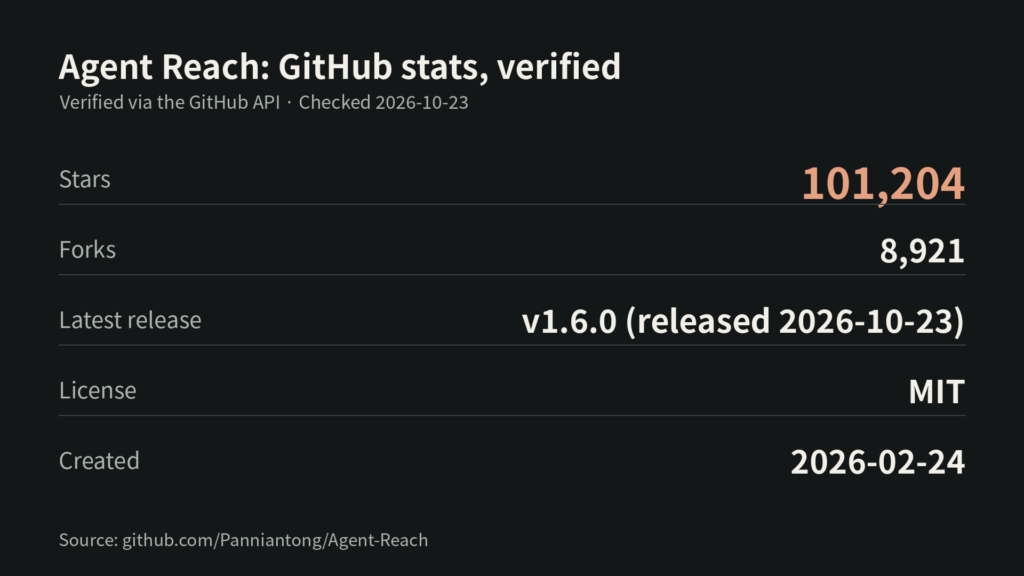
The 100K stars are real. The price is your browser cookies — and why we did not install it.