
HANDS-ON TEST
ElevenLabs Chinese Narration, Tested: Voice and Verification on a 591-Character Long Script
Voice selection and delivery checks for a 591-character Chinese narration.

COST LEDGER
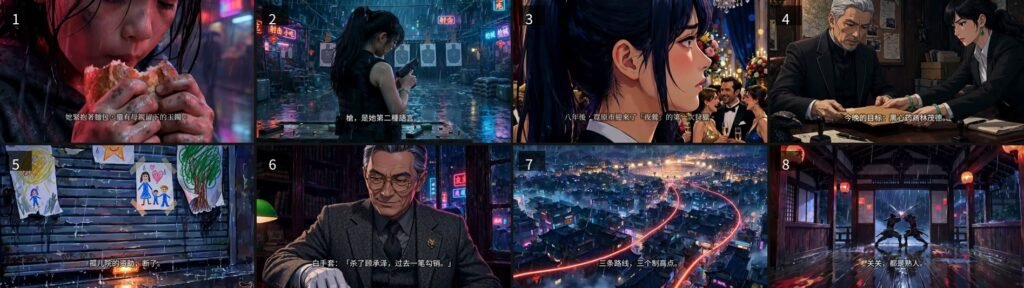
Cash, credits, rework and verification time, recorded separately.
“AI video is cheap” is half true. When Night Huntress season one wrapped — eight episodes — we opened the books: the cash spend really was absurdly small, but only because the bulk of the ledger was never money. It was rebuilt versions and verification hours, plus one licensing bill that surfaced only after delivery. Here is the whole ledger, including the line items that were never recorded — where nothing was logged, this article says so instead of back-filling a plausible number.
Season one’s cost structure: 128 shots generated, 21 full episode renders, about 8 hours of frame-checking — and near-zero per-piece cash, because the generation wasn’t metered per piece. The one item that may still turn into real money is the score’s film licensing, a bill we only discovered after delivery and that is still open.
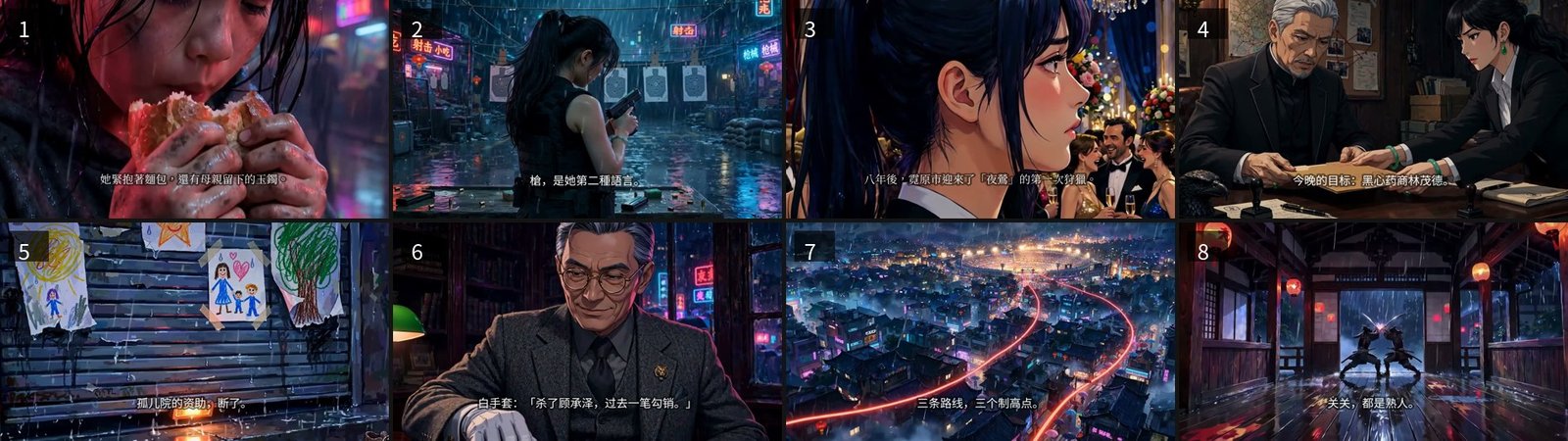
A ledger needs its denominator first. Season one’s output, all from the production records:
| Item | Count | Note |
|---|---|---|
| Episodes | 8, plus a compilation cut | The complete season one delivery |
| Per-episode spec | 16 shots × 10 seconds | 160 seconds of finished episode |
| Total shots | 128 | 8 × 16 |
| Stills generated | At least 128 | At least one locked still per shot |
| Video segments generated | At least 128 | One 10-second image-to-video segment per shot |
| Finished runtime | 1,280 seconds (about 21 minutes) | 8 × 160 seconds |
“At least” is the honest boundary: per-shot regeneration counts (how many attempts each shot took before it locked) were never tallied shot by shot, and this article won’t reconstruct them after the fact. What can be counted from files is whole-episode re-renders — that’s the next table.
The number of finished versions per episode is the most honest redo metric we have — every version is a complete re-assembly and re-render, and every one was triggered by something verification caught:
| Episode | Finished versions | Main redo reasons (from the workflow log) |
|---|---|---|
| Episode 1 | 2 | Pipeline shakedown |
| Episode 2 | 2 | Pipeline shakedown |
| Episode 3 | 7 | Character consistency failed here and produced the face-reference workflow; indoor-rain errors fixed; score re-arranged |
| Episode 4 | 2 | Routine fixes |
| Episode 5 | 1 | Delivered in one version |
| Episode 6 | 2 | Indoor shots given unauthorized rain, fixed |
| Episode 7 | 1 | Delivered in one version |
| Episode 8 | 2 | Routine fixes |
| Compilation | 2 | Assembly fixes |
Nineteen episode versions plus two compilation versions: 21 full renders. Episode 3 alone accounts for seven of them — it was the season’s most expensive tuition. The face-reference workflow (article 1 on this site), the no-indoor-rain rule, and the equal-power crossfade rule for music all came out of this episode’s repeated failures. In other words, redos aren’t waste; they’re how a workflow gets bought. The later episodes could ship in one or two versions because episode 3 had already paid for the rules.
Generation is cheap; verification is not. Every episode runs a fixed procedure: extract frames from every segment, build contact sheets, and review them by eye, shot by shot — checking whether the face drifted, whether rain fell somewhere it shouldn’t, whether costume pieces and props match the bible. As documented in article 1, that runs about 1 hour per episode. Across eight episodes, frame-checking alone is roughly 8 hours — and that excludes:
There is no per-task timesheet for the rest (another unlogged item); the anchor we can stand behind is the verification figure: about 1 hour per episode. When someone tells you an AI short costs only its generation fees, ask them who does the verifying.
Line by line:
| Item | Cash | Note |
|---|---|---|
| Stills and video generation | No per-piece invoices | Produced through the studio’s existing AI toolchain, not metered per piece; subscriptions are a general studio cost and were never allocated to this project, so no figure is printed |
| Editing and assembly | 0 | ffmpeg and in-house pipeline |
| Ambience | 0 | In-house assets (rain, room tone) |
| Narration | 0 | This series is score-and-sound-design only; there is no narration |
| Score | ⚠️ Open | Generated with ElevenLabs; a film-licensing gap — next section |
That last line is the reason this article exists.
The season’s theme (Memory of the Blade) and episode scores were generated with ElevenLabs’ music feature — and at generation time, nobody thought to read the licensing fine print. On 2026-10-14, preparing a festival-platform submission (SinemAI), we read ElevenLabs’ Terms of Use and its music-specific terms end to end and wrote up a confirmation memo. The findings:
The memo lists three options: A. obtain written licensing confirmation from ElevenLabs (an inquiry letter is drafted; lowest cost); B. upgrade to Enterprise Music (custom quote, amount unknown; its terms apply upgrades retroactively to existing outputs); C. replace the score in the submission version (the most work; a replacement track list is already prepared). As of this article’s fact-check date, the bill is still open. The lesson generalizes: AI generation’s “cheap” sometimes means the licensing cost is deferred — deferred to the moment of submission, commercial release or distribution. Even the subscription tier in effect at generation time wasn’t archived (the memo lists it as outstanding), which is its own tuition: our project files now treat “plan tier and terms version at generation time” as a required field.
House rule — this section is never skipped:
Worth doing — but don’t believe “zero cost”. Season one’s ledger proves the cash threshold for AI short films really is low enough for a small studio. The real cost ranking is: (1) redo and verification time, (2) workflow tuition — episode 3’s seven versions, (3) deferred licensing compliance. If you’re starting, log three things from day one: per-shot generation counts, per-task hours, and the plan tier plus terms version in force when you generate. We logged none of the three, and this article is the receipt.
There is no honest total to give: generation ran through the studio’s existing AI toolchain rather than per-piece billing, subscriptions were never allocated to this project, and editing and sound were done in-house. What we can stand behind is the structure — near-zero per-piece cash, with the real costs in redos (21 full renders), verification time (about 8 hours), and one open music-licensing item.
It was the season’s workflow turning point: character consistency failed there, and the face-reference workflow and the indoor-rain rule were both born in that episode — on top of a score re-arrangement and error fixes, totaling seven complete versions. Later episodes shipped in one or two versions precisely because episode 3 had bought the rules.
Using ElevenLabs as the example (checked against its official terms on 2026-10-14): paid users’ outputs are generally commercial, but the music-specific terms exclude film, TV and radio from every self-serve plan; only Enterprise Music covers them. “Commercial” and “usable in film” are two different questions — read the music terms of the plan you’re actually on before you ship.
At Night Huntress’s spec (16 shots × 10 seconds): storyboarding and prompts first; after generation, about an hour per episode of frame-by-frame verification; then human judgment on music seams and sound. Generation itself is the fastest stage — the ledger’s bulk is watching and redoing, not generating.
Three things: per-shot regeneration counts (never tallied — only a floor exists), per-project allocation of tool subscriptions (never logged), and the score licensing’s final resolution (undecided). All three are stated in the article, and the follow-up will be posted when they’re closed.
Our reviews, pricing and licensing-fine-print notes on the major tools live at DC Affiliate — with licensing, read first, pay second.
From character bibles and workflows to full-season delivery and licensing diligence, this pipeline is available as a done-for-you or consulting engagement at David Chen Studio.
HANDS-ON TEST
Voice selection and delivery checks for a 591-character Chinese narration.
PREPARATION
Six first-and-last-frame pairs. Preparation is documented separately from final delivery.