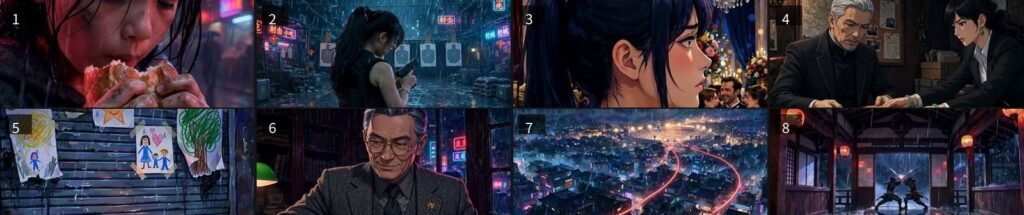
COST LEDGER
What Does an AI Short Film Actually Cost? Night Huntress Season One, Full Ledger
Cash, credits, rework and verification time, recorded separately.

PREPARATION
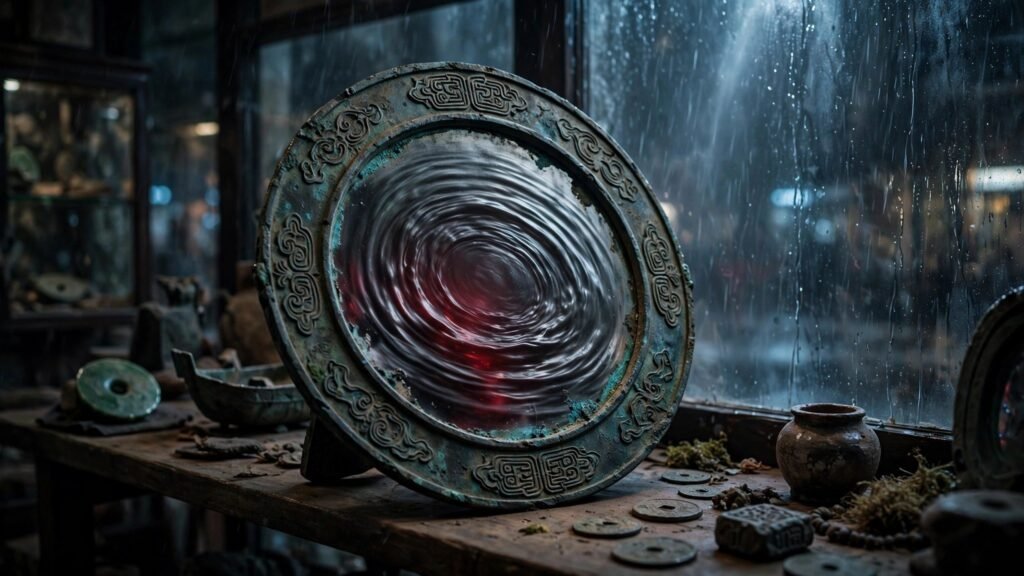
Six first-and-last-frame pairs. Preparation is documented separately from final delivery.
Ten seconds, six shots, and the camera has to travel from a bronze mirror in a modern antique shop, through a shattered mirror membrane, into a colossal tomb and out through a mirror gate. A trailer like that dies if a single cut doesn’t connect. On Twelve Mirror Realms, our answer was to never let the video model decide where a shot starts or ends: both ends are drawn first, and the model is only allowed to fill in the middle.
A trailer’s continuity is mostly decided before you press generate: lock the first and last frames and inspect every one, and the model only interpolates. Prompts describe motion and camera, never appearance. Test the riskiest shot first, and write the fallback before you need it.
Give an image-to-video model only a first frame and it knows where the shot begins — but the ending is improvised. Played alone, the clip may look fine. Cut into a trailer, it breaks: the previous shot ends in a state the next shot’s opening doesn’t match. The mirror hasn’t finished liquefying before we’re inside the tomb; the gate hasn’t finished opening before we pass through it. Audiences don’t need to know any technique to feel the cut “snap”.
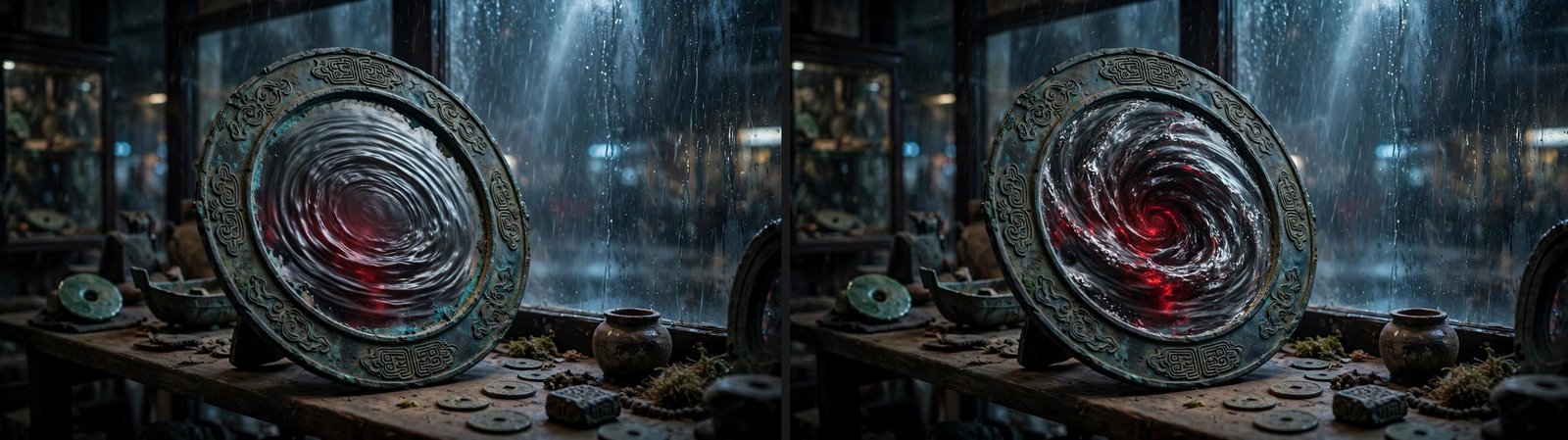
First-and-last-frame mode pins both ends. The first frame is where the shot starts; the last frame is the state it must reach five seconds later; the model’s whole job is to get from one to the other plausibly. Edit points become designable instead of discovered after the fact.
There is one hard rule: the last frame must be the plausible state of the same shot five seconds later — same subject, same spatial logic, same light direction, generated specifically as that future state. It can never be “another nice image”. If the last frame isn’t the first frame’s future, the interpolation warps, jumps color, or invents objects to bridge the gap. The platform rule points the same way: in Kling, an end frame requires a start frame; the pair uploads together.
The six Twelve Mirror Realms pairs were prepared on 2026-09-30 and inspected one by one before entering the generation package:
| Shot | First frame → Last frame | What it locks |
|---|---|---|
| S1 The mirror awakens | Ripples on the mirror’s face → the whole surface liquid, spiraling into a blood-red vortex | The trailer’s first state change: an object becomes alive |
| S2 Through the mirror | First-person plunge at a shattering mirror membrane → bursting into the tomb corridor | The fastest shot in the piece; start and end spaces must align exactly |
| S3 Kunlun tomb, the beast wakes | The stone beast’s eyes closed → blazing red eyes open, gears and chains in motion | “Awakening” is a state, not a camera move; the last frame is the proof it happened |
| S4 Detail montage | A four-quadrant collage → diving into the ancient-eye close-up, mirror worlds in its pupil | Where a dissolving collage lands: the last frame decides which quadrant we enter |
| S5 The mirror gate opens | The gate sealed → stone erupting open, the mirrored duplicate flashing into view | Both the instant before and the instant after the break, drawn in advance |
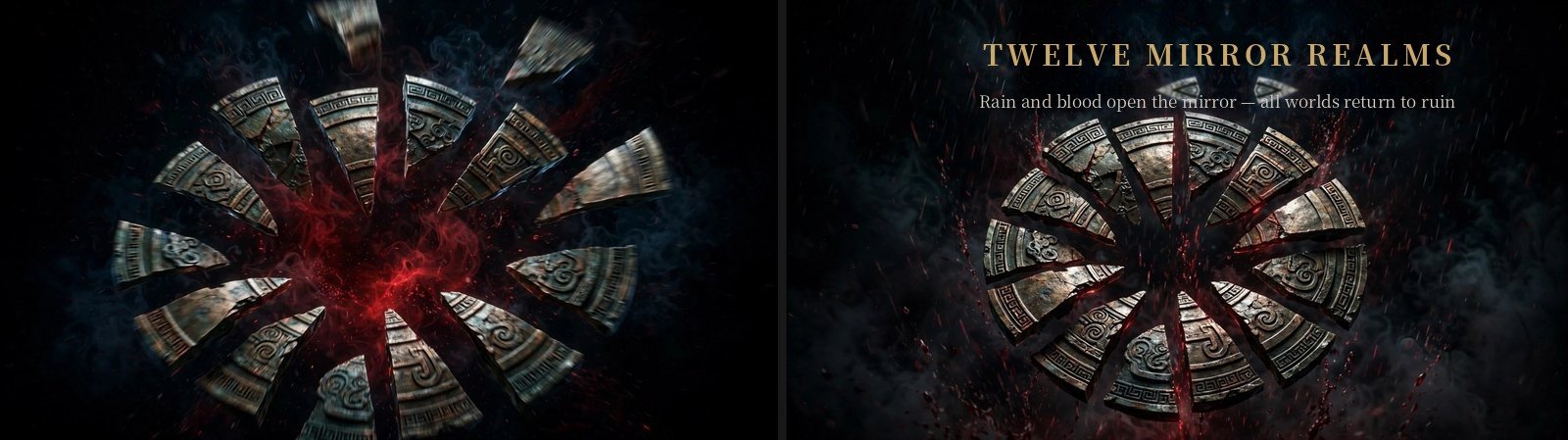
| S6 Title card | Fragments scattered → twelve fragments locked into a circular emblem, the title lit | The highest-risk shot in the piece: Chinese glyphs — see the test order below |
S4 shows the value of a last frame best. The first frame is a four-panel collage and the camera dives into one panel — the ancient eye. Which panel, and what the shot finally rests on, would take paragraphs of prompt to specify; one last-frame image settles it.
Because appearance already lives in the frames. Each of our motion prompts covers exactly four things: the subject’s change of state, the camera move, light and atmosphere, and the sound direction (Kling’s native audio; per the project’s Bible this trailer is a sound-effects-only design with no narration). Each runs about 90–130 English words, far under Kling’s 2,500-character prompt cap — the prompt load is deliberately small, and the frames carry the visual information.
The other discipline is the negative prompt field. Kling’s negative field takes the excluded thing itself, no “no” needed. All six shots share one list — wuxia costumes, European castles, Japanese architecture, cyberpunk, anime, face morphing, extra fingers, watermarks, subtitles — not out of fussiness, but to hold the “photoreal Chinese fantasy” line: the things a model most loves to sneak in are exactly what’s on that list.
Kling has Elements: upload character references under a name, cite them as @name in prompts, and faces stay locked. We prepared an upload pack (the three leads — Jichen, Li Yuhan and Yezi — up to four multi-angle portraits each, cropped to the portrait only, no text labels), but these six shots deliberately don’t use it: they are scene-led shots, and the only people in them are the tiny backlit silhouettes in S3 and S5. There are no faces to lock.
The reason is practitioner experience: enabling element references can slightly degrade image quality. That price is worth paying on shots where a face carries the scene — not on scenery. It’s the same principle we run on Night Huntress: use the lock where it matters (there, the lead’s face is on screen throughout, so everything cites her face reference).
Test order follows risk, not shot order. S6 carries the highest risk in the piece: it asks the video model to render correct Chinese glyphs in motion — the four large characters 十二鏡界 (Twelve Mirror Realms) plus the tagline 雨血開鏡,萬世歸墟. Glyph rendering is a binary outcome: right, and the shot proceeds as planned; wrong, and the shot’s whole approach changes.
So S6 is generated first, with the fallback written in advance: if the glyphs fail, generate a clean plate — emblem locking together, blood rain falling upward — and composite the title card in the edit. It’s a static card anyway; compositing is arguably the steadier craft. Test the most expensive risk first, so the free credits don’t get spent in the wrong direction (the credit math is next).
Every shot generates at 5 seconds: Kling 3.0 supports 3–15 seconds, 5 is the quality-per-cost sweet spot, and the clips are then trimmed to the Bible’s timeline in the edit (S1 0–1.5s, S2 1.5–3.2s, S3 3.2–5.2s, S4 5.2–7.1s, S5 7.1–8.6s, S6 8.6–10s).
| Item | Figure | Source / note |
|---|---|---|
| One generation | 5 seconds ≈ 10 credits | Generation package notes, 2026-09-30 |
| One full round, six shots | ≈ 60 credits | 6 shots × 10 credits |
| Free-tier allowance | 66 credits / day | One day of free credits covers exactly one round — no slack for retries |
| Free-tier limits | 720p, watermarked, non-commercial | A finished ad cannot ship from the free tier |
| Paid (Standard) | ≈ US$10/month (first month ≈ $6.99) | Checked 2026-09; commercial rights + no watermark |
| Native audio | Paid tiers only | On free, test the picture first and design sound in post |
The line everyone misses: failed generations still consume credits, and failure rates climb at peak hours. A 60-credit plan on a 66-credit day means one failure pushes the rest to tomorrow — the second reason S6 goes first: spend a few credits retiring the biggest uncertainty before committing the sequence.
House rule — this section is never skipped:
Recommended — for the prep discipline. If you are making a multi-shot AI trailer or short, build and inspect every shot’s first and last frames before generating anything: continuity gets locked at that stage, prompts stay motion-only, the riskiest shot is tested first, and the fallback is written before it’s needed. The one reservation keeping this from a full score: the Kling run itself hasn’t happened, so interpolation quality and the S6 glyph outcome are still open questions — we’ll report them here after the run rather than let prep discipline impersonate generation results.
With only a first frame, the model improvises the ending, and edit points across a multi-shot piece become uncontrollable. With both ends locked, the model only interpolates the process between them — every shot’s end state is designed in advance, so the cuts hold.
No. The last frame has to be the same shot’s plausible future state — same subject, same spatial logic, same light. An unrelated image as the last frame makes the interpolation warp or jump color. All six of our last frames were generated specifically as “what this shot should look like five seconds later”.
These six shots are scene-led; the only people are small backlit silhouettes, so there are no faces to lock. Element references can slightly degrade image quality in practice, so we reserve them for later face-critical shots (up to four multi-angle portraits per lead, cited as @name).
The riskiest one. We queued S6, the title card: Chinese glyph rendering is a binary pass/fail, and if it fails we switch to the fallback — a clean plate plus the title composited in the edit. With 66 free credits a day and failures still charging, retiring the biggest uncertainty first is the cheapest order.
On the prep side, generating and inspecting 12 frames. On the Kling side, six 5-second clips run about 60 credits — one day of free-tier allowance covers one full round (a watermark-free, commercially licensed result needs a paid tier; Standard was about US$10/month when checked in 2026-09).
Our reviews, pricing and use-case notes on Kling and the other video generators live at DC Affiliate — same hands-on standard, same costs on the table.
From storyboards and frame prep to the finished cut, this pipeline is available as a done-for-you or consulting engagement at David Chen Studio.
COST LEDGER
Cash, credits, rework and verification time, recorded separately.

HANDS-ON TEST
Voice selection and delivery checks for a 591-character Chinese narration.